Showing posts with label Edo. Show all posts

Monday, February 1, 2016

The Pilgrim - Shun'ei Katsukawa

Ichikawa Danjuro by night, in the role of rokuju-rokubu, or pilgrim to the sixty six  Buddhist Shrines in as many provinces. He wears a portable shrine on his back and holds a shakujo staff in his hands with a mokugyo attached to his waistband. A fine and famous design. cir 1780

 Ukiyo-e painter, print maker (1762 - 1819). A man of diverse interests: musician, a devotee of the theatre, a painter of witty sketches and caricatures. Lived in Edo. Brilliant pupil of Katsukawa Shunsho, whose surname he adopted. Specialized in actor prints and scenes from plays, giving an individual and at times biting characterization to his portraits. May have started the fashion for okudi-e of actors, though many critics credit Shunko with this innovation.At his best from 1791 to 1795, influencing both Sharaku and Toyokuni. Also illustrated books, including the seven volumes of Shibai Kimmo Zui (An Encyclopedia of the Theatre). By 1800 one of most prominent ukiyo-e figures and leader of the Katsukawa school.


Monday, October 12, 2015

Still Life Surimono - Icho

A still life with decorated bowl, scissors and battledore bat. Shikishiban Surimono. Fine with gauffrage and use of gold and silver pigments

This is a rare Surimono print by Icho about who little is known.

Sunday, December 2, 2012

Thirty Six Views of Fuji ; Fuji from the Tama River - Katsushika Hokusai

Mount Fuji rising majestically from a band of mist above the Tama river. One of the best designs from the set.(ca 1831) Katsushika Hokusai (October 31, 1760 – May 10, 1849) was a Japanese artist, ukiyo-e painter and printmaker of the Edo period. He was influenced by such painters as Sesshu, and other styles of Chinese painting. Born in Edo (now Tokyo), Hokusai is best known as author of the woodblock print series Thirty-six Views of Mount Fuji (Fugaku Sanjūroku-kei, c. 1831) which includes the internationally recognized print, The Great Wave off Kanagawa, created during the 1820s. Hokusai created the "Thirty-Six Views" both as a response to a domestic travel boom and as part of a personal obsession with Mount Fuji. It was this series, specifically The Great Wave print and Fuji in Clear Weather, that secured Hokusai’s fame both in Japan and overseas. As historian Richard Lane concludes, "Indeed, if there is one work that made Hokusai's name, both in Japan and abroad, it must be this monumental print-series...". While Hokusai's work prior to this series is certainly important, it was not until this series that he gained broad recognition. Hokusai's date of birth is not known for certain, but is often said to be the 23rd day of the 9th month of the 10th year of the Hōreki era (in the old calendar, or October 31, 1760) to an artisan family, in the Katsushika district of Edo, Japan. His childhood name was Tokitarō. It is believed his father was the mirror-maker Nakajima Ise, who produced mirrors for the shogun. His father never made Hokusai an heir, so it is possible that his mother was a concubine.[6] Hokusai began painting around the age of six, possibly learning the art from his father, whose work on mirrors also included the painting of designs around the mirrors. Hokusai was known by at least thirty names during his lifetime. Although the use of multiple names was a common practice of Japanese artists of the time, the numbers of names he used far exceeds that of any other major Japanese artist. Hokusai's name changes are so frequent, and so often related to changes in his artistic production and style, that they are useful for breaking his life up into periods. At the age of 12, he was sent by his father to work in a bookshop and lending library, a popular type of institution in Japanese cities, where reading books made from wood-cut blocks was a popular entertainment of the middle and upper classes. At 14, he became an apprentice to a wood-carver, where he worked until the age of 18, whereupon he was accepted into the studio of Katsukawa Shunshō. Shunshō was an artist of ukiyo-e, a style of wood block prints and paintings that Hokusai would master, and head of the so-called Katsukawa school. Ukiyo-e, as practiced by artists like Shunshō, focused on images of the courtesans and Kabuki actors who were popular in Japan's cities at the time. After a year, Hokusai's name changed for the first time, when he was dubbed Shunrō by his master. It was under this name that he published his first prints, a series of pictures of Kabuki actors published in 1779. During the decade he worked in Shunshō's studio, Hokusai was married to his first wife, about whom very little is known except that she died in the early 1790s. He married again in 1797, although this second wife also died after a short time. He fathered two sons and three daughters with these two wives, and his youngest daughter Sakae, also known as Ōi, eventually became an artist. Upon the death of Shunshō in 1793, Hokusai began exploring other styles of art, including European styles he was exposed to through French and Dutch copper engravings he was able to acquire. He was soon expelled from the Katsukawa school by Shunkō, the chief disciple of Shunshō, possibly due to studies at the rival Kanō school. This event was, in his own words, inspirational: "What really motivated the development of my artistic style was the embarrassment I suffered at Shunkō's hands." The print Red Fuji from Hokusai's series, Thirty-six Views of Mount Fuji. Travellers Crossing the Oi River, one of the ten prints Hokusai added to the original 36 prints in 36 Views of Mount Fuji. He was prompted to add these prints because of the popularity of the original series. The Apparition of Mt Fuji on the 5th year of Korei.Manga/ 1814. Hokusai also changed the subjects of his works, moving away from the images of courtesans and actors that were the traditional subjects of ukiyo-e. Instead, his work became focused on landscapes and images of the daily life of Japanese people from a variety of social levels. This change of subject was a breakthrough in ukiyo-e and in Hokusai's career. Fireworks at Ryōgoku Bridge (1790) dates from this period of Hokusai's life The next period saw Hokusai's association with the Tawaraya School and the adoption of the name "Tawaraya Sōri". He produced many brush paintings, called surimono, and illustrations for kyōka ehon (illustrated book of humorous poems) during this time. In 1798, Hokusai passed his name on to a pupil and set out as an independent artist, free from ties to a school for the first time, adopting the name Hokusai Tomisa. Cranes from Quick Lessons in Simplified Drawing By 1800, Hokusai was further developing his use of ukiyo-e for purposes other than portraiture. He had also adopted the name he would most widely be known by, Katsushika Hokusai, the former name referring to the part of Edo where he was born and the latter meaning, 'north studio'. That year, he published two collections of landscapes, Famous Sights of the Eastern Capital and Eight Views of Edo. He also began to attract students of his own, eventually teaching 50 pupils over the course of his life. He became increasingly famous over the next decade, both due to his artwork and his talent for self-promotion. During a Tokyo festival in 1804, he created a portrait of the Buddhist priest Daruma said to be 600 feet (180 m) long using a broom and buckets full of ink. Another story places him in the court of the Shogun Iyenari, invited there to compete with another artist who practiced more traditional brush stroke painting. Hokusai's painting, created in front of the Shogun, consisted of painting a blue curve on paper, then chasing a chicken across it whose feet had been dipped in red paint. He described the painting to the Shogun as a landscape showing the Tatsuta River with red maple leaves floating in it, winning the competition. 1807 saw Hokusai collaborate with the popular novelist Takizawa Bakin on a series of illustrated books. The two did not get along due to artistic differences, and their collaboration ended during work on their fourth book. The publisher, given the choice between keeping Hokusai or Bakin on the project, opted to keep Hokusai, emphasizing the importance of illustrations in printed works of the period. Image of bathers from the Hokusai manga In 1811, at the age of 51, Hokusai changed his name to Taito and entered the period in which he created the Hokusai Manga and various etehon, or art manuals. These etehon, beginning in 1812 with Quick Lessons in Simplified Drawing, served as a convenient way to make money and attract more students. The first book of Hokusai's manga, sketches or caricatures that influenced the modern form of comics known by the same name, was published in 1814. Together, his 12 volumes of manga published before 1820 and three more published posthumously include thousands of drawings of animals, religious figures, and everyday people. They often have humorous overtones, and were very popular at the time. In 1820, Hokusai changed his name yet again, this time to "Iitsu," a change which marked the start of a period in which he secured fame as an artist throughout Japan (though, given Japan's isolation from the outside world during his lifetime, his fame overseas came after his death). It was during the 1820s that Hokusai reached the peak of his career. His most famous work, Thirty-six Views of Mount Fuji, including the famous Great Wave off Kanagawa, dated from this period. It proved so popular that Hokusai later added ten more prints to the series. Among the other popular series of prints he published during this time are A Tour of the Waterfalls of the Provinces and Unusual Views of Celebrated Bridges in the Provinces. He also began producing a number of detailed individual images of flowers and birds, including the extraordinarily detailed Poppies and Flock of Chickens The next period, beginning in 1834, saw Hokusai working under the name "Gakyō Rōjin Manji" (The Old Man Mad About Art). It was at this time that Hokusai produced One Hundred Views of Mount Fuji, another significant landscape series. ” In 1839, disaster struck as a fire destroyed Hokusai's studio and much of his work. By this time, his career was beginning to wane as younger artists such as Andō Hiroshige became increasingly popular. But Hokusai never stopped painting, and completed Ducks in a Stream at the age of 87. Constantly seeking to produce better work, he apparently exclaimed on his deathbed, "If only Heaven will give me just another ten years... Just another five more years, then I could become a real painter." He died on May 10, 1849 (18th day of the 4th month of the 2nd year of the Kaei era by the old calendar), and was buried at the Seikyō-ji in Tokyo (Taito Ward)

Monday, October 15, 2012

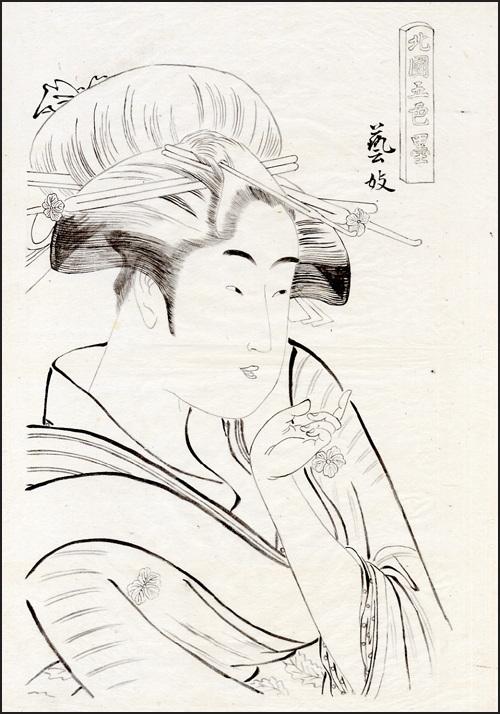
Large Head portrait - Kitagawa Utamaro 1797

A delightful preliminary study for a series "Five Shades of Ink in the Northern Quarter". This design does not appear to have been used for publication. For another example of a preparatory drawing with similarly "unfinished" coiffure, see Hillier, Utamaro, pg 12, fig 2.

Kitagawa Utamaro (ca. 1753 – October 31, 1806) was a Japanese print maker and painter, who is considered one of the greatest artists of woodblock prints (ukiyo-e). His name was Romanized as Outamaro. He is known especially for his masterfully composed studies of women, known as bijin-ga. He also produced nature studies, particularly illustrated books of insects. His work reached Europe in the mid-nineteenth century, where it was very popular, enjoying particular acclaim in France. He influenced the European Impressionists, particularly with his use of partial views and his emphasis on light and shade. The reference to the "Japanese influence" among these artists often refers to the work of Utamaro.

Kitagawa Ichitarō (later Utamaro) was born either in Edo (present-day Tokyo), Kyoto, or Osaka, or in a provincial town, in 1753. Another long-standing tradition asserts that he was born in Yoshiwara, the courtesan district of Edo, being the son of a tea-house owner, but there is no evidence of this. Following the Japanese custom of the time, he changed his name as he became mature, and also took the name, Ichitarō Yusuke. Despite Kitagawa Utamaro’s success and celebrity status among his own world of popular culture, history of his life and career is insufficient. Apparently, Art Historians faces the facts that there are no contemporary documents to help them certify his date of birth, birthplace, and family background – there have been theories and these are the most accepted – he was born in 1753, probably Edo, and his father was an owner of a Tea-house. Kobayashi wrote, “Kitagawa Utamaro was an outstanding figure in the world of popular art and literature, but that world itself was at the bottom of the social scale. The low status of the ukiyo-e artist meant that the details of his life remain buried in obscurity” (Kobayashi, p 34). Print from Yamanba and Kintaro Sakazuki series Apparently, Utamaro married, although little is known about his wife and there is no record of their having had children. There are, however, many prints of tender and intimate domestic scenes of the same woman and child over several years of the child's growth among his works. Generally, it is agreed that while he was still a child, he became a pupil of the painter Toriyama Sekien. There are many authorities who believe that Utamaro was his son as well. He did live in Sekien's house while he was growing up and the relationship between the two artists continued until Sekien's death in 1788. Sekien originally was trained in the aristocratic Kanō School of painting, but in middle age he started to lean toward the popular Ukiyo-e, a genre of Japanese woodblock prints. Sekien is known to have had a number of other pupils, who failed to achieve distinction. At the approximate age of twenty-two, his earliest known major professional artistic work was created, a cover for a Kabuki playbook in 1775 that was published under a pseudonym, the gō of Toyoaki. He then produced a number of actor and warrior prints, along with theatre programmes, and other such materials. From the spring of 1781, he switched his gō to Utamaro, and began painting and designing woodblock prints of women, but these early works are not considered of important value. At some point in the mid-1780s, probably 1783, he went to live with the young and rising publisher, Tsutaya Jūzaburō. It is estimated that he lived there for approximately five years. He seems to have become a principal artist for the Tsutaya firm. Evidence of his prints for the next few years is sporadic, as he mostly produced illustrations for books of kyoka, literally 'crazy verse', a parody of the classical waka form. None of his work produced during the period 1790-1792 has survived. Flowers of Edo: Young Woman's Narrative Chanting to the Samisen c. 1800 In about 1791 Utamaro gave up designing prints for books and concentrated on making single portraits of women displayed in half-length, rather than the prints of women in groups favoured by other ukiyo-e artists. In 1793 he achieved recognition as an artist, and his semi-exclusive arrangement with the publisher Tsutaya Jūzaburō was terminated. He then went on to produce several very famous series of works, all featuring women of the Yoshiwara district. Over the years, he also occupied himself with a number of volumes of animal, insect, and nature studies and shunga, or erotica. Shunga prints were quite acceptable in Japanese culture, not associated with a negative concept of pornography as found in western cultures, but considered rather as a natural aspect of human behavior, and circulated among all levels of Japanese society. In 1797, Tsutaya Jūzaburō died and apparently, Utamaro was very upset by the loss of his long-time friend and supporter. Some commentators feel that after this event, his work never reached the heights it had previously. In 1804, at the height of his success, he ran into legal trouble by publishing prints related to a banned historical novel. The prints, entitled Hideyoshi and his Five Concubines, depicted the wife and concubines of the military ruler, Toyotomi Hideyoshi, who lived from 1536 to 1598. Consequently, Utamaro was accused of insulting the real Hideyoshi's dignity. He was sentenced to be handcuffed for fifty days (some accounts say he briefly was imprisoned). According to some sources, the experience crushed him emotionally and ended his career as an artist. He died two years later, on the twentieth day of the ninth month of 1806 (the lunar calendar date format for October 31), aged about fifty-three, in Edo.

Monday, May 7, 2012

Bijin at Dinner - Chobunsai Eishi (ca. 1790)


An elegenat seated bijin in a restaurant. A rare design unknown to Brant Yellow ground.


Chôbunsai Eishi (Hosoda Tokitomi)was an ukiyo-e painter and print designer, known primarily for his depictions of tall, thin, graceful beauties. (Born: 1756 - Died: 1829)

The eldest son of a local Edo samurai official of the Hosoda family, Eishi studied under Kanô Michinobu, and served as an official court painter to the shogunate for a number of years. He held hatamoto rank and had an income of 500 koku. His art-name, Eishi, was granted him by the shogun Tokugawa Ieharu himself. Chôbunsai is likewise a pseudonym, a studio name, using the character sai (斎) in its meaning of "studio," much as did the artists Hokusai, Kôryûsai, Keisai Eisen and Ichiryûsai Hiroshige.

In the mid-1780s, however, Eishi made a dramatic change, and moved from the realm of elite painting to ukiyo-e. After working on illustrations for kibyôshi for several years, in 1789, he began producing ukiyo-e works in earnest, including single-sheet prints and paintings. His style shows influence from Utamaro, Torii Kiyonaga and others, but bears distinctive elements as well. Eishi's women are tall and slender, a continuation and development of a trend begun by Utamaro and Kiyonaga, and they bear a refinement and grace rarely exceeded by the figures in bijinga by other artists.

Around 1798, he quit print designs, and turned his attention more fully to painting. It is said that one of his handscrolls, depicting scenes along the Sumidagawa, so impressed the wealthy patrons for whom it was painted that they presented it at a special showing to the Imperial family. This was an especially rare honor for a plebian ukiyo-e piece, one which perhaps no other ukiyo-e artist ever enjoyed.

Though Eishi never formally established a school and trained but a few direct pupils, ukiyo-e connoisseur Richard Lane identifies a number of artists who followed in Eishi's footsteps, describing them as "among the most fascinating secondary figures in ukiyo-e history". They include Eishôsai Chôki, Chôkôsai Eishô, Rekisentei Eiri, Chôkyôsai Eiri, and Ichirakutei Eisui.

Monday, February 20, 2012

Sumi Pillar Print : Shoki the Demon Queller - Utagawa Toyoharu ca. 1760


A striking portrait of "the Demon Queller" executed in Sumi. See Pins, the Pillar Print page 325 #919

Utagawa Toyoharu (1735–1814) was a Japanese printmaker and founder of the Utagawa school. Born in the Kansai region of Japan, he studied in Kyoto under Tsuruzawa Tangei, a Kanō school painter, before moving to Edo in 1760. There he continued his studies under Toriyama Sekien. Toyoharu played an important role in the development of Ukiyo-e by studying western linear perspective in his Uki-e prints. Engravings after the venetian vedutisti such as Canaletto and Guardi were his primary source of information about perspective. He also reproduced these views of Venice and Rome in full color woodblock prints. His primary innovation, however, was his adaptation of linear perspective to Japanese subject matter.

Saturday, February 4, 2012

Double Size Primitive Print: The Flaming Pearl - Torii Kiyonobu I ca. 1715


A magnificant representation of the dragon and the flaming pearl from the earliest period of Ukiyo-e. Unsigned but probably by Kiyonobu I or Kiyomasu I

Torii Kiyonobu I ( c. 1664 - August 22, 1729) was a Japanese painter and print maker in the ukiyo-e style, who is renowned for his work on Kabuki signboards and related materials. Along with his father Torii Kiyomoto, he is said to have been one of the founders of the Torii school of painting.

Known in childhood as Shōbei, young Kiyonobu was the second son of the established Osaka kabuki actor and painter Torii Kiyomoto. He moved, with his father, to Edo (modern-day Tokyo) when he was twenty-four, and emerged there as a major artist with a unique style. Kiyonobu's work is regarded as being highly influenced by that of Hishikawa Moronobu (d. 1694), the father of ukiyo-e; Kiyonobu would also have been well-versed, as most major artists were at the time, in the styles of the Kanō and Tosa schools.

Kiyonobu focused almost exclusively on producing billboards and other promotional material for Edo's kabuki theaters; the relationship between the theaters and the Torii school was a strong and important one, and one that continues today. Guided by the need to attract attention, Kiyonobu's style tended towards bold, colorful exuberance. In addition to a distinctive use of color, details, and various other aesthetic elements, the Torii style is especially distinguished by the use of thick, bold line.

By 1700, Kiyonobu was a fully established and accomplished artist. His works were praised by contemporary writers, and were often even placed in Shintō shrines as votive offerings, a fact which indicates something of the artistic quality or emotional impact of his depictions of Kabuki actors. By the time of his death in 1729, Kiyonobu had not only painted a great number of signboards and the like, but had also produced illustrations for woodblock printed books, depicting kabuki dramas, and had issued individual prints as well.

As is the case with most Torii school artists, Kiyonobu's dates are not known for sure, and the relationships between the various Torii artists are similarly unclear. The styles of Kiyonobu's disciples and relatives are very similar, and most scholars entertain the possibility that Kiyonobu II or Kiyomasu I were the same man as the subject of this article, Kiyonobu I, or as one another. Very few, if any, paintings created by the Torii school are known definitely to have been painted by any one particular artist.

Wednesday, November 2, 2011

Portrait of Kyoden - Eiri CHOKYOSAI


A dark gray mica ground bust portrait of the poet Santo Kyoden. ca. 1795

There has been much confusion about this artist. Three artists have been considered as using "Chokosai", "Rekisentei" and "Shikyusai" with "Eiri"; or they might have been one person. He was a student of Eishi Hosoda.

Monday, October 24, 2011

The Straw Cape - Katsukawa Shunshō


The actor Ichikawa Danjuro in Kumadori make up, in the act of drawing his sword, disguised in a peasants straw cape. This important design is probably for the role of Kagekiyo in the play Okazari Kotobuki. Soga performed in the Kiri za in 1786.

Katsukawa Shunshō (1726 - January 19, 1792) was a Japanese painter and printmaker in the ukiyo-e style, and the leading artist of the Katsukawa school. Shunshō studied under Miyagawa Shunsui, son and student of Miyagawa Chōshun, both equally famous and talented ukiyo-e artists. Shunshō is most well known for introducing a new form of yakusha-e, prints depicting Kabuki actors. However, his bijin ga (images of beautiful women) paintings, while less famous, are said by some scholars to be "the best in the second half of the [18th] century".

Shunshō first came to Edo to study haiku and painting. He became a noted printmaker of actors with his first works dating from 1760. Though originally a member of the Torii school, he soon broke away and began his own style, which would later be dubbed the Katsukawa school. Among his students were the famous ukiyo-e artists Shunchō, Shun'ei, and Hokusai.